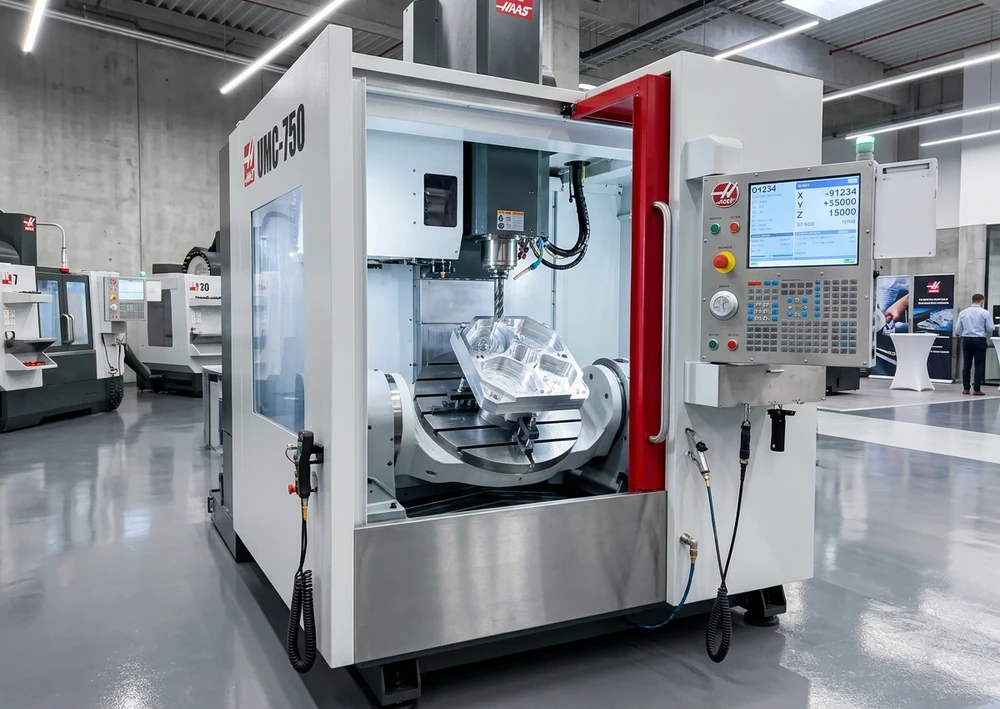
Few machines have democratized multi-axis manufacturing as effectively as the HAAS UMC-750 Universal Machining Center. By pairing an integrated dual-axis rotary trunnion table with the intuitive Haas Next Generation Control (NGC), the UMC-750 delivers an exceptional balance of work envelope, rigidity, and rapid ROI for both 3+2 indexed positioning and full simultaneous 5-axis contouring.
Grounded in the 10-Vendor CNC Controller Deep-Dive in Chapter 3 (pp. 30, 34–37) and Appendices A14 and A16 of The Art & Science of 5-Axis Machining, this article explores how to unlock the full capability of the HAAS UMC-750—from its B/C trunnion kinematics and essential G234 TCPC / G254 DWO coordinate transformations to table load optimization and MRZP calibration.
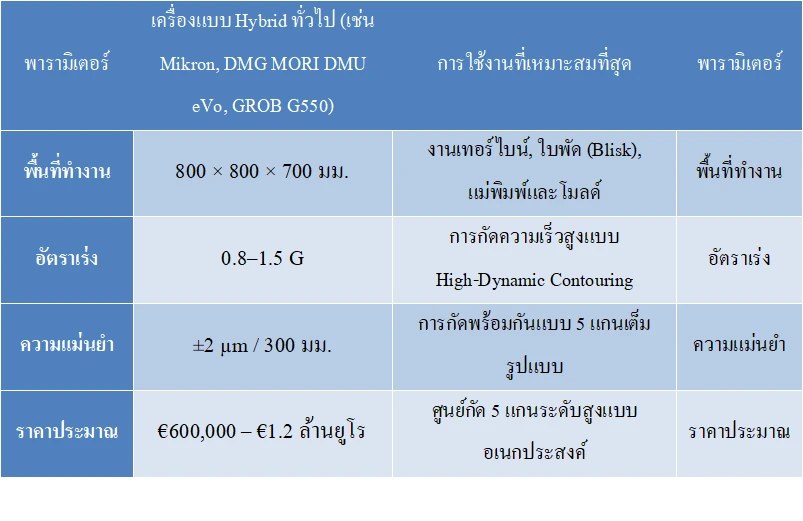
G234 (Tool Center Point Control) & G254 (Dynamic Work Offset): Place fixtures anywhere on the platter without reposting CAM programs.M130 Media Display & Safe Run: Streamlined shop-floor setup and collision protection.In the Chapter 3 comparative analysis of ten global CNC controller platforms (Section 3.7, p. 30 & pp. 34–37), the Haas Next Generation Control (NGC) stands out for its straightforward operation, rapid learning curve, and tightly integrated shop-floor productivity tools:
M130: Programmers can embed M130 media calls directly inside the NC program to display high-resolution setup photos, clamping instructions, and inspection videos right on the operator pendant during execution.Safe Run Mode & Axis Load Monitoring: Allows operators to prove out new 5-axis programs with heightened sensitivity so unexpected axis loads halt motion before serious mechanical damage occurs.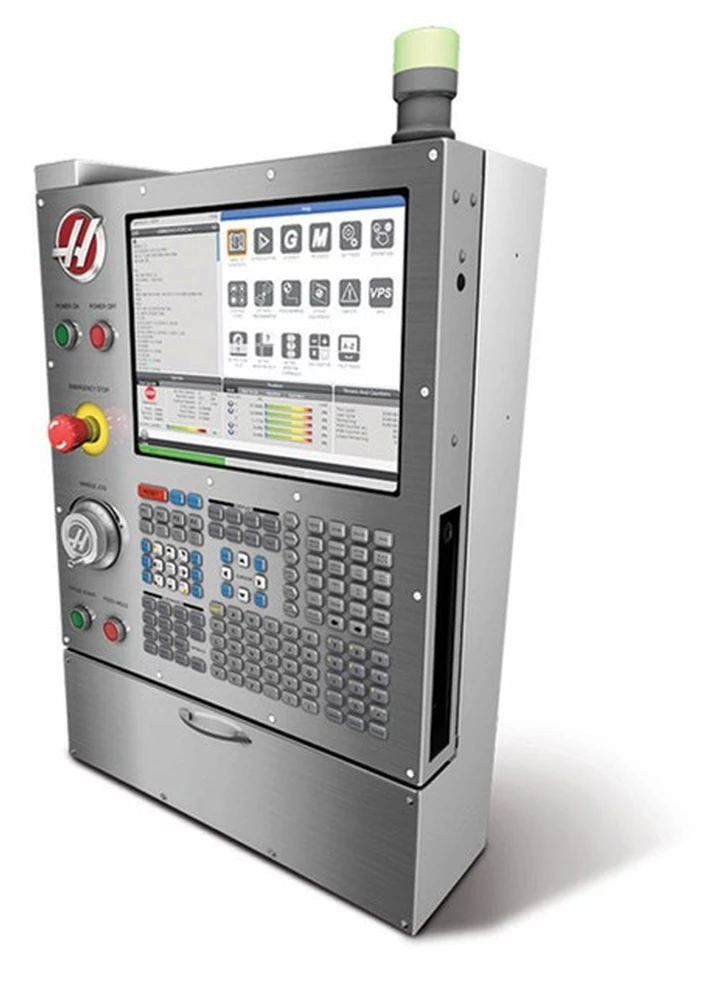
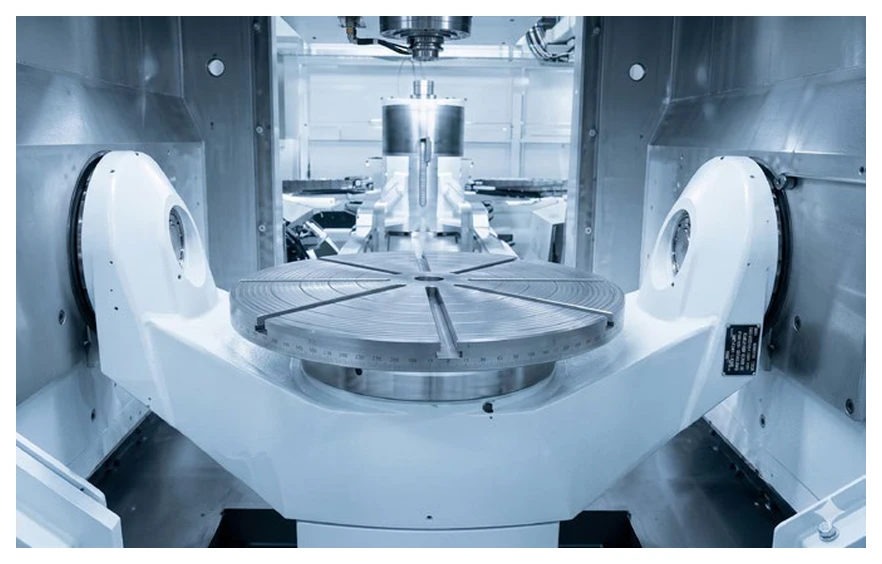
As classified in Appendix A14 (p. 210), the HAAS UMC-750 employs a Trunnion-Table (Table/Table) 5-axis architecture: all linear translations (X = 762 mm, Y = 508 mm, Z = 508 mm) occur in the overhead spindle head, while the dual-axis trunnion provides B-axis tilt (+120° to -35°) and 360° C-axis rotation on a Ø500 mm platter with T-slots and a precision pilot bore.
Key kinematic advantages of this configuration include:
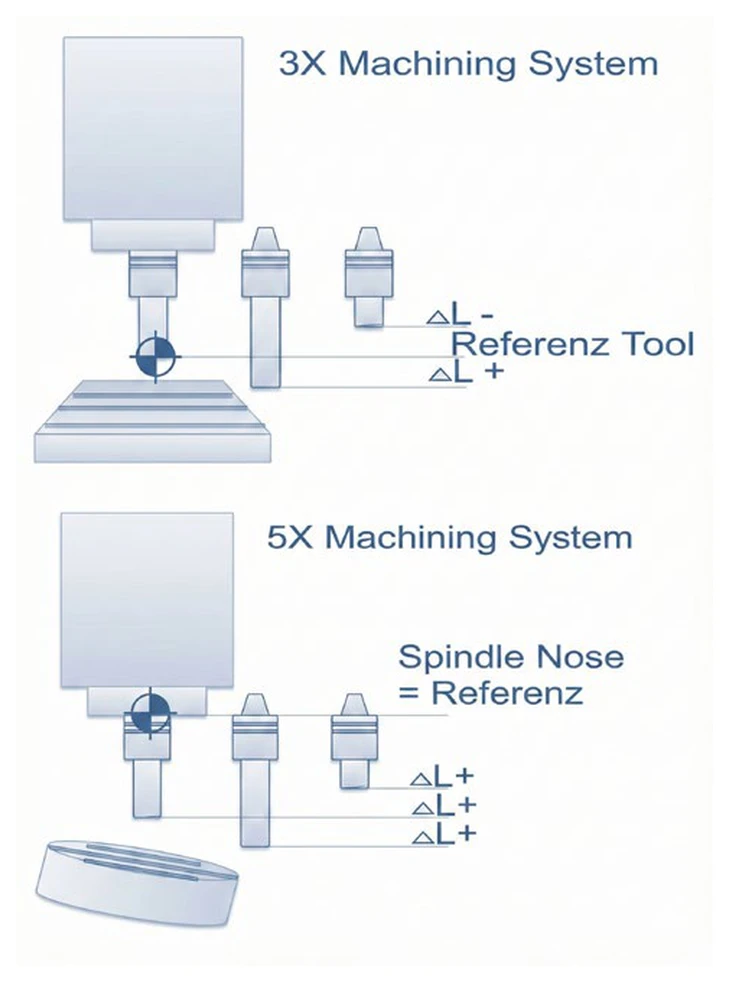
Historically, 5-axis programming required mounting the workpiece at the exact rotary center coordinates assumed inside the CAM file—moving the vise by even 0.5 mm forced a trip back to the CAM workstation to repost the G-code. On the HAAS UMC-750, two coordinate-transformation functions eliminate this limitation completely (pp. 30, 40):
| Haas G-Code | Function Name | Engineering Operation |
|---|---|---|
G254 | Dynamic Work Offset (DWO) | Designed for 3+2 positioned (tilted working plane) machining. After rotary axes B and C index to a tilted angle, G254 dynamically calculates the new spatial location of the part’s work offset (e.g., G54) relative to the trunnion pivot point. |
G234 | Tool Center Point Control (TCPC) | Designed for full 5-axis simultaneous motion. Continuously tracks tool length offset ($H$) and rotary kinematics in real time so the cutter tip follows the programmed 3D path smoothly while X, Y, Z, B, and C interpolate simultaneously. |
Together, G254 and G234 decouple the CAM program from fixture placement on the platter: operators simply bolt down the zero-point vise, probe the part origin once, and press Cycle Start.
To preserve micron-level accuracy and dynamic responsiveness on a trunnion-style machine like the HAAS UMC-750 (300 kg platter capacity), Chapters 5 (p. 47) and 11 (pp. 144–145) outline essential physics guidelines for workpiece placement and calibration:
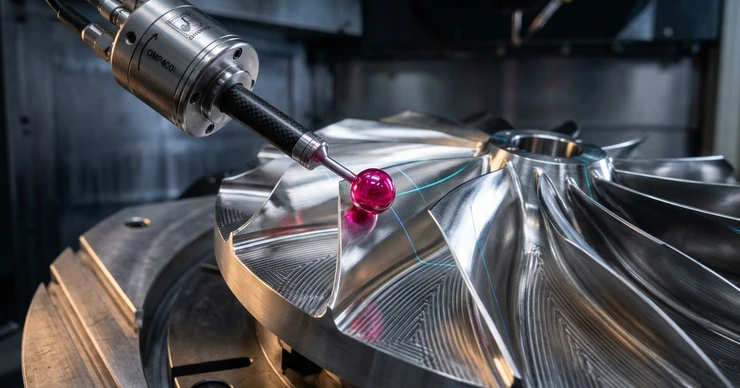
G234 TCPC and G254 DWO rely on the exact X, Y, Z intersection coordinates of the B and C rotary axes stored in control settings, run the automated WIPS probing cycle against a magnetic calibration sphere periodically to keep kinematic offsets true within microns.
© 2022 Machine Tech Co., Ltd. All Rights Reserved. Web design by 1001click.