Mastering Aerospace Standards: Precision 5-Axis Milling Techniques for Titanium and Inconel Down to the Micron
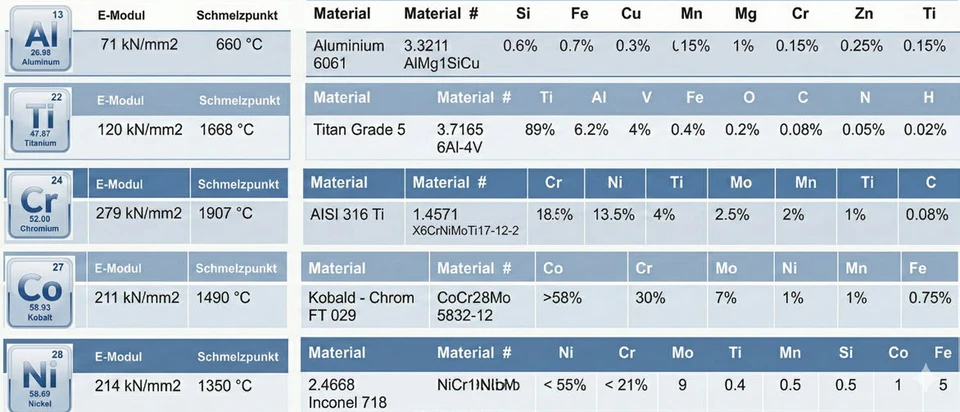
In aerospace propulsion, structural airframes, and power generation turbines, Titanium alloys (such as Ti-6Al-4V / Grade 5) and nickel-based Heat-Resistant Superalloys (HRSA such as Inconel 718) are irreplaceable due to their exceptional strength-to-weight ratios and structural stability at extreme temperatures. Yet the very metallurgical properties that make them ideal in flight make them the ultimate test of a 5-axis CNC machining system.
Drawing directly from the Titanium & HRSA Playbooks in Appendix A12 (pp. 152–187) and Appendix A13 of The Art & Science of 5-Axis Machining, machining Titanium and Inconel down to the micron requires mastering their thermal physics, operating strictly inside the “$f_z$ Reality Box”, controlling radial engagement, and deploying high-pressure through-spindle cooling.
Four Golden Rules for Machining Titanium and Inconel 718
Master Thermal Concentration & Work-Hardening Physics: Titanium traps ~80% of cutting heat in the tool edge, while Inconel work-hardens instantly if rubbed.
Stay Inside the “$f_z$ Reality Box”: Never drop feed per tooth ($f_z$) below the cutting-edge hone radius ($r_\beta$).
Enforce Climb Milling with Low Radial Engagement ($a_e \le 8\%\text{–}15\%\ D$): Maximize cooling time per revolution while preventing exit burr welding.
Deploy 70–100 Bar Through-Spindle Coolant or Supercritical $\text{CO}_2$: Penetrate the thermal vapor barrier right at the shear zone.
1. Material Science of Ti-6Al-4V and Inconel 718: Why Conventional Parameters Fail
As emphasized in the opening of Appendix A12 (p. 152), conquering exotic aerospace alloys starts with understanding their metallurgical behavior inside the shear zone:
Extreme Thermal Concentration (Low Thermal Conductivity): Whereas carbon steel ($\sim 50\ \text{W/m}\cdot\text{K}$) evacuates most cutting heat into the flying chip, Ti-6Al-4V has a thermal conductivity of only $\sim 6.7\ \text{W/m}\cdot\text{K}$ (and Inconel 718 only $\sim 11.4\ \text{W/m}\cdot\text{K}$). Consequently, up to 80% of thermal energy is trapped directly inside the carbide cutting edge, rapidly softening the binder and triggering plastic deformation.
Low Modulus of Elasticity in Titanium ($E \approx 110\ \text{GPa}$): At roughly half the stiffness of steel, thin titanium sections deflect elastically away from the cutter and spring back against the relief flank, inducing harmonic chatter and flank rubbing.
Severe Strain-Hardening & Abrasive Carbides in Inconel 718: Nickel-based superalloys work-harden rapidly during plastic shear, creating a hardened skin that causes severe depth-of-cut line notch wear and built-up edge (BUE) welding.
2. The fz Reality Box: Avoiding the Deadly Rubbing Zone vs. Edge Overload
When confronted with tough Titanium or Inconel, the most destructive operator instinct is dialing down the feedrate override to “baby the tool.” In Appendix A12 (p. 187), Roland Zaugg introduces the “$f_z$ Reality Box — The Uncomfortable Truth”: even the finest carbide grade and coating will fail prematurely if feed per tooth ($f_z$) falls outside its physical shear window:
The Sub-Threshold Rubbing Zone ($f_z$ Too Low): Every coated carbide edge has a microscopic edge-hone radius ($r_\beta \approx 5\text{–}15\ \mu\text{m}$). If uncompensated $f_z$ produces a mean chip thickness ($h_m$) smaller than $r_\beta$, the flute cannot shear a chip—it ploughs and rubs against the surface, causing extreme frictional heat, instantaneous work-hardening of Inconel, and rapid thermal crater/flank failure.
The Overload Fracture Zone ($f_z$ Too High): Exceeding the transverse rupture strength of the carbide edge causes mechanical micro-chipping and sudden flute breakage.
Operating Inside the $f_z$ Reality Box: Programmers must apply Radial Chip Thinning calculations whenever radial stepover is small ($a_e = 8\%\text{–}15\%\ D$) so true chip thickness remains solidly within the $h_m = 0.04\text{–}0.10\ \text{mm}$ shearing window.
3. Cutting Parameters, Coating Selection, and Strict Climb Milling Strategy
Beyond chip-thickness control, the Titanium and HRSA Playbooks in Appendix A12 establish strict parameter and tooling rules for 5-axis aerospace production:
Key Parameter
Titanium (Ti-6Al-4V)
Inconel 718 / HRSA
Engineering Rationale
Cutting Speed ($V_c$, Carbide)
45 – 80 m/min (up to 110 m/min in HDC)
25 – 45 m/min (Ceramics: 500–800 m/min)
Keeps interface temperature below the thermal softening point of the carbide binder.
Radial Engagement ($a_e$)
8% – 15% of $D$
5% – 12% of $D$
Minimizes arc of contact so each flute spends >85% of every revolution being cooled.
Milling Direction
Strict Climb Milling (Down Milling)
Climb Milling + Arc Roll-In
Starts cut at maximum chip thickness and exits thin, eliminating entry rubbing.
Optimal PVD Coating
AlTiN / AlCrN (Avoid pure TiCN/TiC)
Nanocomposite AlTiN / TiSiN
Forms a protective aluminum-oxide thermal barrier and resists titanium galling.
Deploying 5- to 7-flute variable-helix, variable-pitch solid carbide end mills with polished flutes disrupts regenerative chatter harmonics and prevents chip re-cutting.
4. High-Pressure Coolant (70–100 Bar) and Supercritical CO2 Cooling Technology
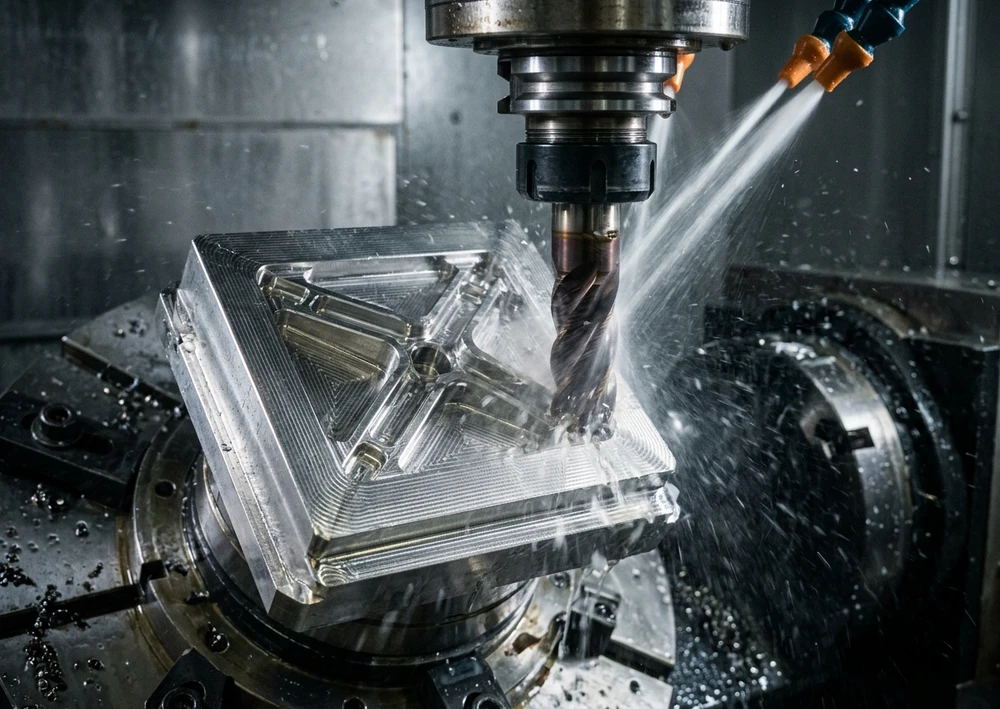
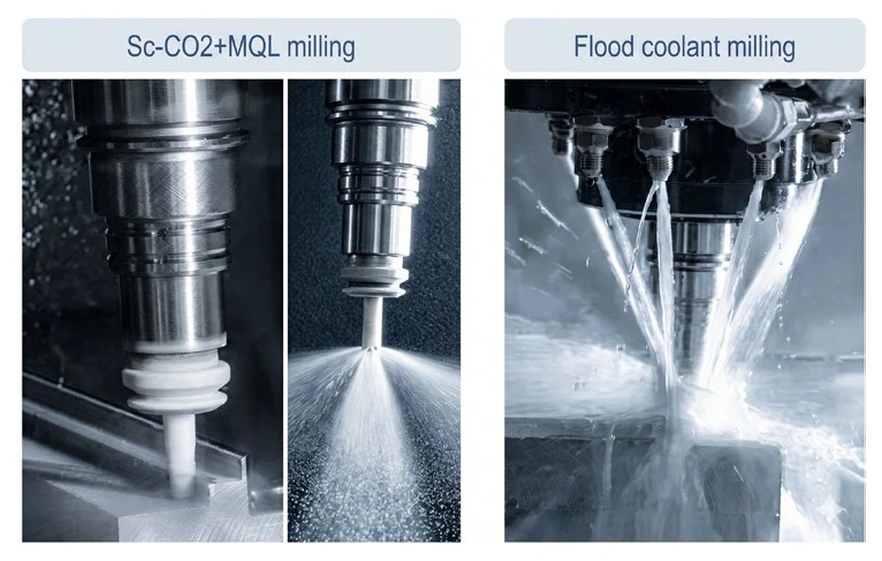
During aggressive milling of Titanium and Inconel, conventional low-pressure flood coolant flashes into steam before reaching the cutting edge—forming an insulating Leidenfrost vapor barrier that leaves the tool tip uncooled.
Appendix A13 (pp. 193–202) details two mission-critical cooling technologies for aerospace 5-axis machining:
High-Pressure Through-Spindle Coolant (70–100 bar TSC): Directed through internal coolant channels in the holder and cutter, a 70–100 bar hydraulic jet blasts straight through the vapor barrier into the primary shear zone—quenching edge temperature, acting as a hydraulic chip breaker, and flushing stringy chips out of deep 5-axis pockets.
Supercritical $\text{CO}_2$ Cooling ($\text{scCO}_2$ — pp. 201–202): By pressurizing $\text{CO}_2$ above its critical point ($\sim 31\ ^\circ\text{C}, \sim 74\ \text{bar}$), the fluid achieves liquid-like density with gas-like diffusivity, dissolving tiny doses of MQL oil homogeneously. Upon expanding out of the tool tip nozzles, the Joule-Thomson effect delivers intense cryogenic cooling right at the cutting edge—boosting tool life and cutting speeds in Ti-6Al-4V and Inconel 718 by 30–50% with zero wastewater or part contamination.