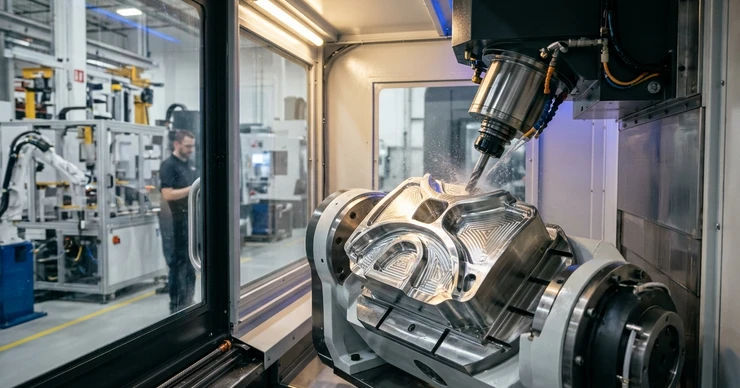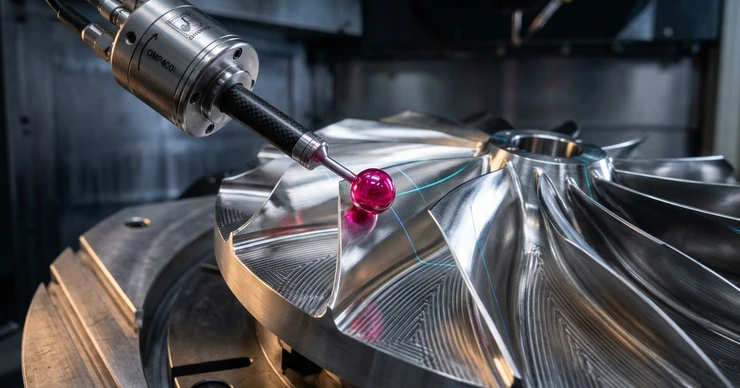
True excellence in 5-axis CNC manufacturing is measured over years, not days. Producing a single first-article component within micron tolerances is a technical achievement; reproducing that exact same geometric fidelity tens of thousands of times across seasonal temperature swings, multi-shift operations, and years of mechanical duty is the hallmark of Sustainable 5-Axis Manufacturing. As Roland Zaugg emphasizes in the Appendix Abstract of The Art & Science of 5-Axis Machining (pp. 150–151): "If the main text explains how to achieve precision, the engineering appendices explain why that precision endures over the long term."
In modern precision engineering, sustainability is not merely an environmental buzzword—it is a holistic operational strategy that unites ecological resource efficiency, operator occupational health and safety, metalworking fluid longevity, preventive mechanical maintenance, and closed-loop volumetric calibration. A machine shop that neglects coolant chemistry, spindle taper hygiene, or thermal/kinematic drift inevitably suffers from premature spindle failures, hazardous shop-floor mist, excessive tool consumption, and scrapped high-value aerospace or medical components.
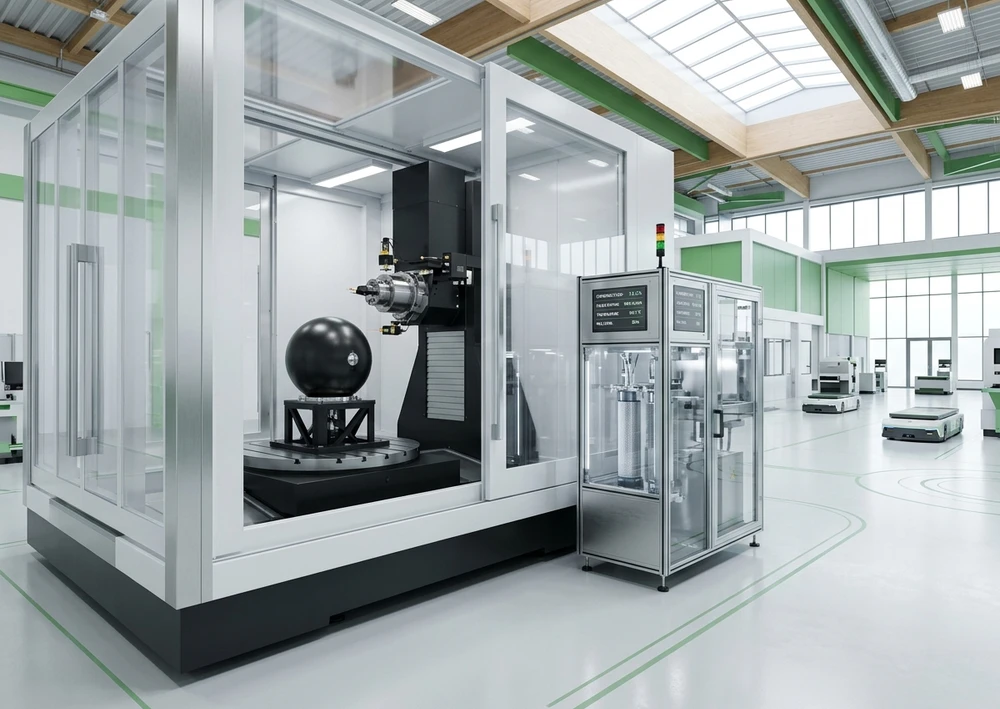
By harmonizing Material Flow, Resource Flow, and Data Flow (pp. 16–18) with disciplined maintenance and calibration protocols, manufacturers can maximize spindle utilization, slash energy consumption per part, and preserve the geometric integrity of their 5-axis machine tools for decades.
KinematicsOpt, AMC, VCS, MAZA-CHECK, MRZP, Renishaw Ballbar, and LaserTRACER) to maintain ±5–10 µm TCP accuracy year after year.Sustainable 5-axis manufacturing begins with designing a holistic production ecosystem that minimizes raw material waste, electrical energy consumption per part, and non-productive machine idle time. In the Introduction and Chapter 1 (pp. 10–18), Roland Zaugg emphasizes that the future of advanced manufacturing lies not in competition between technologies, but in Smart Hybrid Manufacturing—seamlessly integrating near-net-shape Additive Manufacturing (Powder Bed Fusion such as DMLS, SLM, and EBM) with high-precision Subtractive 5-Axis Finishing.
While additive processes excel at generating complex internal cooling channels and lightweight bionic topologies, they cannot achieve functional bearing fits, sealing surfaces, or micron-level geometric tolerances on their own. By mounting near-net-shape additive blanks onto standardized zero-point pallets for single-setup 5-axis finishing, manufacturers dramatically reduce the "buy-to-fly" material waste ratio in expensive titanium and nickel superalloys. Simultaneously, synchronizing Material Flow, Resource Flow, and Data Flow (pp. 16–18) via Digital Twin verification and High-Dynamic Cutting (HDC) toolpaths cuts cycle times by 30–45%, directly lowering spindle and auxiliary chiller kilowatt-hour consumption per finished component.
Equally decisive for economic sustainability is maximizing Spindle Utilization by eliminating on-machine setup downtime through Zero-Point Pallet Systems. As demonstrated in Zaugg's payback benchmark in Chapter 11 (pp. 138–139):
| Productivity & Sustainability Metric | Conventional On-Machine Setup | Zero-Point Pallet & 5-Axis Ecosystem | Economic & Resource Sustainability Impact |
|---|---|---|---|
| Daily Setup Time (per 8-hour shift) | 4.0 hours (manual indicating on table) | 0.5 hours (offline presetting on pallets) | Reduces non-productive machine idle time by 87.5% |
| Weekly Spindle Cutting Hours (5 days) | 20.0 hours/week | 37.5 hours/week (+87.5% utilization) | Nearly doubles output without expanding factory floor space or HVAC load |
| Total Investment & Weekly Revenue (€50/hr) | €150,000 CapEx / €1,000 per week | €160,000 CapEx / €1,875 per week | Cuts capital payback period from 150 weeks down to 85 weeks |
| Material & Energy Efficiency | Multi-setup billet hogging; high scrap risk | Hybrid Additive/Near-Net + Single-Clamping HDC | Reduces cycle energy per part by 30–45% and eliminates datum transfer scrap |
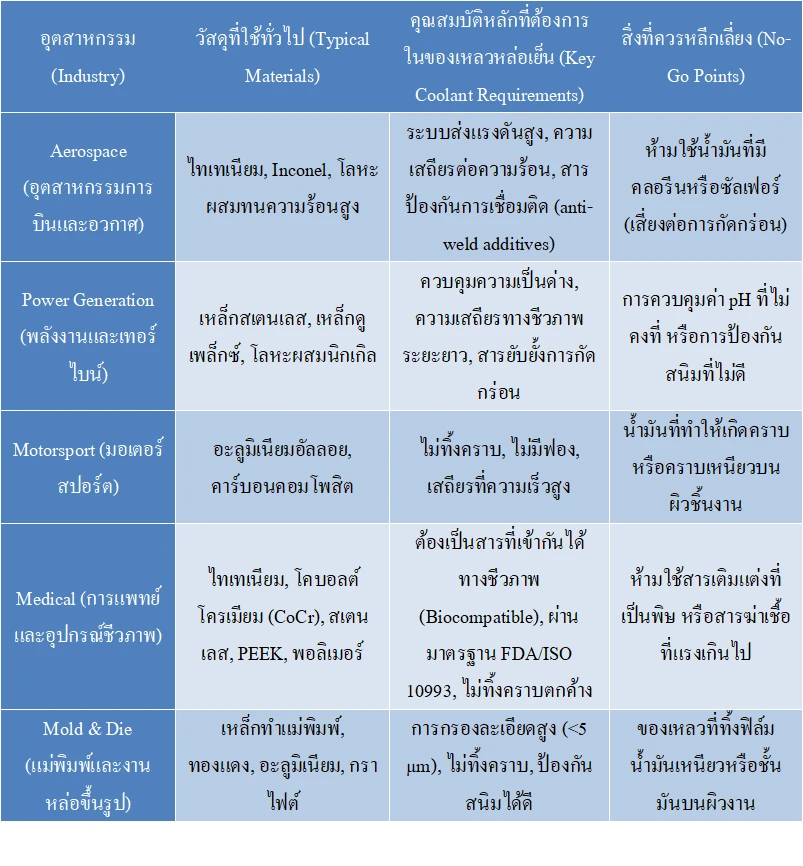
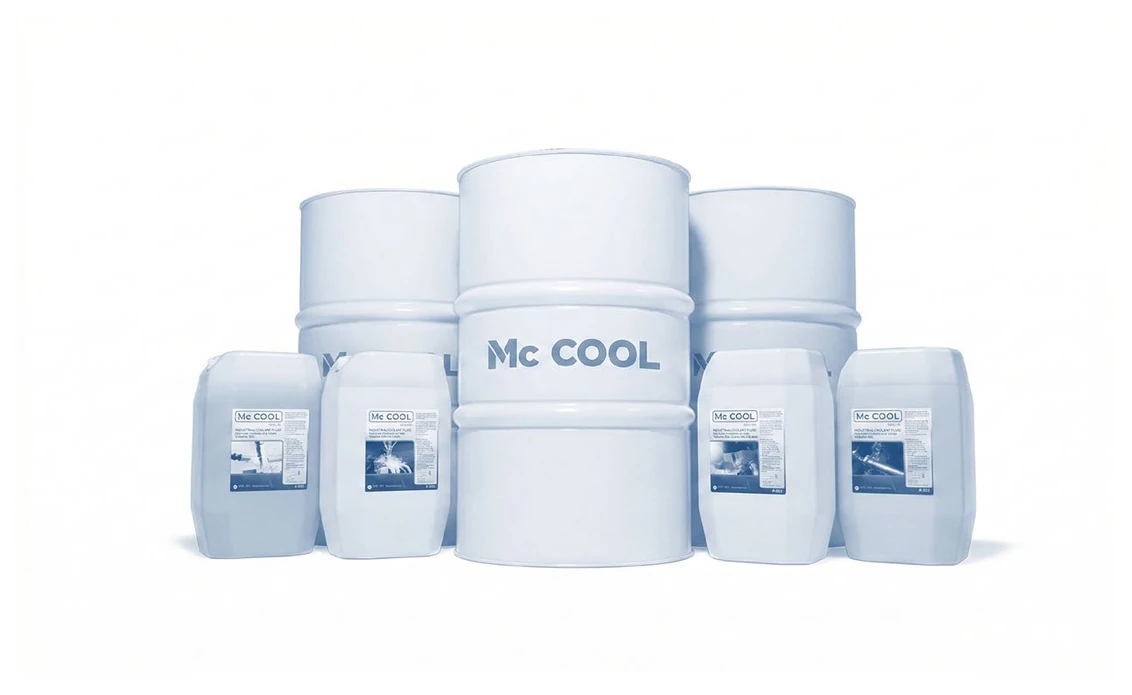
In Appendix A13 (pp. 188–205), Roland Zaugg defines metalworking coolant not as a disposable commodity, but as "the lifeblood of the metal-cutting process—process control in liquid form." Remarkably, shop-floor audits reveal that over 80% of coolant-related failures stem not from chemical formulation defects, but from maintenance neglect! Achieving long-term ecological sustainability, extended sump life, and operator occupational safety requires mastering four critical domains:
Blasogrind GTC 7) when paired with fine filtration (≤ 5 µm). Wet graphite milling eliminates hazardous airborne dust, prevents electrode edge chipping, and saves up to six figures annually per machine by eliminating dry-to-wet changeover downtime.| Fluid & Health Parameter | Target Engineering Window | Consequence of Neglect | Sustainable Shop-Floor Protocol |
|---|---|---|---|
| Make-Up Water Hardness | 8 – 20 °dH | < 5 °dH causes severe foaming; > 25 °dH forms sticky soap scum deposits |
Condition regional tap water using Reverse Osmosis (RO) + controlled blending |
| Concentration & Alkalinity | c% = 6 – 10% (Material specific) pH = 8.5 – 9.4 |
pH < 8.0 breeds anaerobic bacteria & rust; pH > 9.5 causes operator skin irritation |
Log refractometer & pH weekly; always add oil into water; skim tramp oil & aerate |
| Cobalt-59 Mist & Particulate Control | ≤ 5 µm fine filtration + Enclosed Mist Extraction | Dissolved Co ions in mist cause asthma, lung fibrosis & EU Carc. 1B cancer risk | Install ≤ 5 µm filtration, mist collectors, monitor sump Co levels, and use FFP3 PPE |
| Eco-Regulatory & Clean Cooling | Boron-Free / Formaldehyde-Free, MQL, or Cryogenic CO2 | High hazardous waste disposal cost; non-compliance with REACH/medical rules | Deploy MQL for HSC aluminum/steel and Supercritical CO2 for medical/HRSA parts |
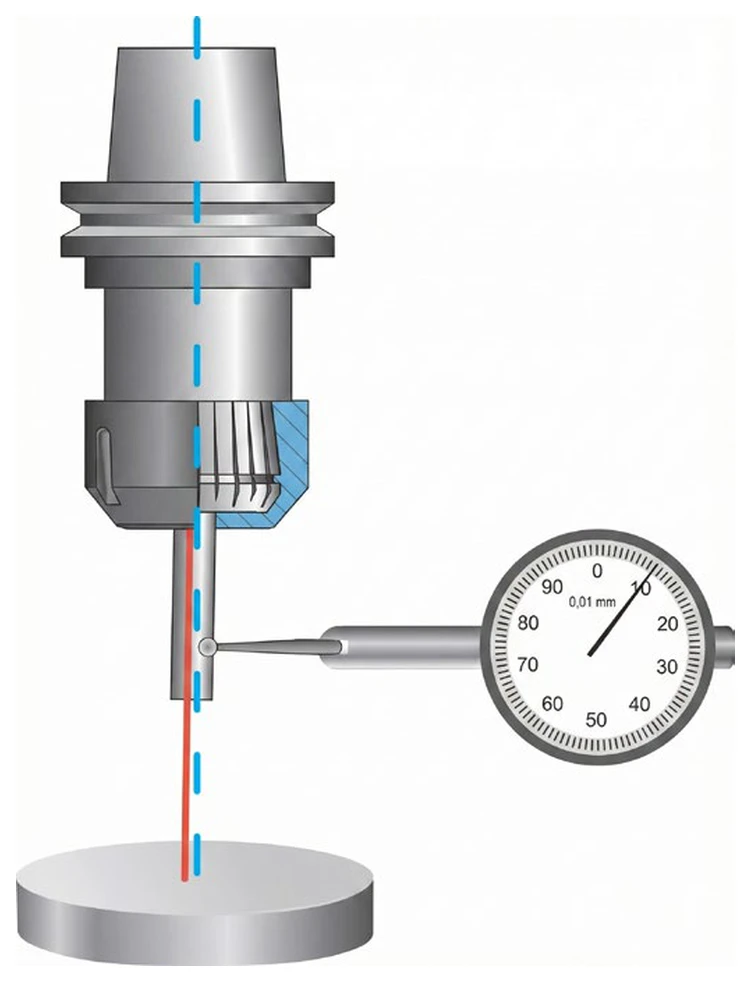
Long-term mechanical stability in 5-axis machining depends on treating tool holders, spindle interfaces, and zero-point workholding as precision wear components rather than indestructible steel blocks. In Chapter 10 (pp. 129–131), Roland Zaugg outlines a comprehensive Combined Inspection & Maintenance Checklist designed to prevent gradual accuracy degradation and protect high-speed spindles from premature failure.
1. Spindle-to-Holder Interface ("The First Interface") Preventive Maintenance:
2. Holder-to-Tool ("The Second Interface") & Workholding Maintenance:
| Maintenance Inspection Point | Recommended Cadence | Verification Tool & Method | Pass/Fail Criteria & Corrective Action |
|---|---|---|---|
| Spindle Bore & Holder Taper/Flange (HSK / BT / PSC) | Every tool assembly / Daily per shift | Lint-free alcohol wipe + visual/bluing check for fretting corrosion | Zero fretting or galling allowed; retire damaged holders immediately (never hand-polish) |
| Assembly Concentricity (TIR Runout @ 3×D) | Every preset + immediately after any tool breakage or crash | Optical or dial indicator presetting station at 3×D overhang | TIR ≤ 3 µm for finishing; quarantine holder if runout exceeds 5 µm |
| Spindle Drawbar Force & Holder Grip Torque | Monthly to Quarterly | Calibrated drawbar force gauge & hydraulic chuck pressure tester | Restore OEM drawbar clamping force; re-pressurize or service hydraulic chucks |
| Collets, 80-Bar Coolant Seals & Zero-Point Chucks | Every 6–12 months (or per cycle limit) | Pressure leak check, collet bore inspection, and zero-point seating check | Replace worn collets and O-ring seals proactively; verify ≤ 2 µm pallet repeatability |
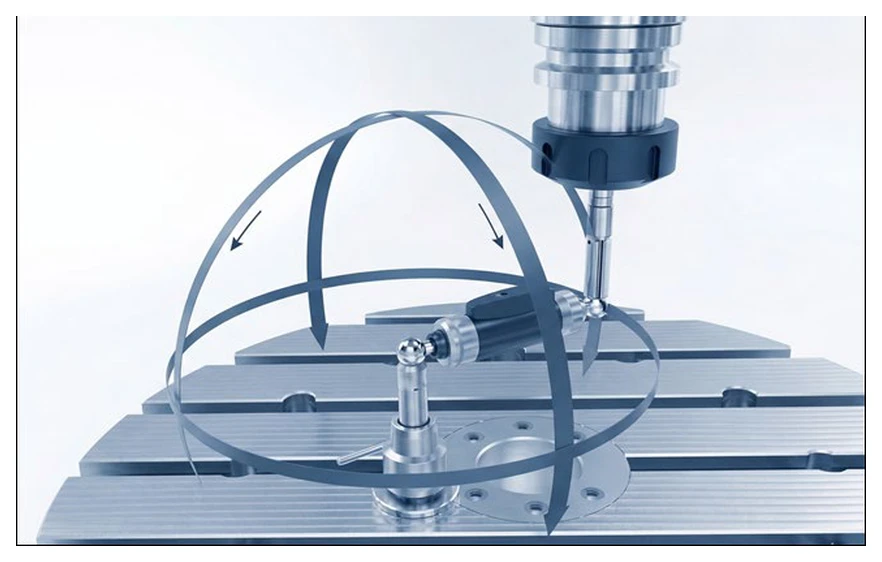
The ultimate pillar of sustainable 5-axis manufacturing is guaranteeing that a programmed toolpath produces the exact same micron-accurate geometry five years from now as it did on day one. In Appendix A16 (pp. 228–235), Roland Zaugg states a foundational law of multi-axis metrology: "A five-axis machine tool—no matter how expensive—is only as accurate as the geometry its controller believes it has."
Over months and years of production, every machine tool experiences physical geometry shifts caused by ambient temperature swings exceeding ±2 °C, seasonal foundation settling, heavy fixture load changes, spindle thermal growth, or minor mechanical overloads. When the physical pivot points (Centers of Rotation: CoR) and tilt axis vectors drift away from the controller's internal mathematical kinematic model, uncompensated machines suffer positional error accumulation of 20–50 µm per 100 mm of travel, twisted 3+2 planes, and visible blend mismatches during simultaneous 5-axis surfacing.
Establishing a Closed-Loop Calibration & Thermal Compensation Cadence (pp. 229–235):
KinematicsOpt / KinematicsComp / Cycle 307, Mikron AMC – Autonomous Machine Calibration, Siemens VCS, Okuma 5-Axis Auto Tuning, Mazak MAZA-CHECK, Haas MRZP, and DMG MORI 3D quickSET). Running these routines restores TCP accuracy to ±5–10 µm in minutes.| Calibration Tier | Recommended Interval | Shop-Floor Trigger Event | Controller Cycles & Metrology Instruments |
|---|---|---|---|
| 1. 3D Touch Probe & Tool Setter Calibration | Daily / Every Shift | Stylus replacement, overload, or > 5 µm probing drift | Master ring gauge, calibration sphere, and native CNC probe cycles |
| 2. Short Kinematic Check (3+2 Pivot & Tilt) | Weekly / Per Critical Batch | Ambient temperature shift > ±2 °C or heavy fixture change | KinematicsOpt, Mikron AMC, 3D quickSET, MAZA-CHECK, Haas MRZP |
| 3. Full 5-Axis Kinematic Calibration | Monthly to Quarterly | Post-maintenance, collision recovery, or seasonal shift | KinematicsComp, Okuma 5-Axis Auto Tuning, Renishaw AxiSet™ Check-Up |
| 4. 43-DOF Volumetric Mapping & ISO Audit | Annually (OEM Service + QA) | Geometric deviation > 10 µm or annual ISO 230 / ISO 10791 audit | Renishaw QC20-W Ballbar, XR20, Etalon LaserTRACER, Siemens VCS, ISO 10791-7 test piece |
© 2022 Machine Tech Co., Ltd. All Rights Reserved. Web design by 1001click.